

What Is Eid al-Adha?
Eid al-Adha, the Festival of Sacrifice, falls on the 10th of Dhul Hijjah, the day after the Day of Arafah, and is one of the two major celebrations in Islam alongside Eid al-Fitr. Where Eid al-Fitr marks the conclusion of Ramadan’s month of fasting, Eid al-Adha marks the culmination of the Hajj pilgrimage and the first ten days of Dhul Hijjah, which the Prophet, peace be upon him, described as the best days of the year.
It is a day of prayer, of sacrifice, of generosity, and of communal joy. But its joy is not hollow. It is joy that arrives at the end of a spiritually demanding season, earned through fasting, worship, giving, and reflection. The celebration of Eid al-Adha is inseparable from the meaning behind it, and that meaning begins with Ibrahim.
The Story Behind the Celebration
Eid al-Adha commemorates one of the defining moments in the history of prophethood: the moment Ibrahim, peace be upon him, demonstrated a completeness of submission to Allah that the Quran describes as the highest expression of faith.
Allah commanded Ibrahim through a dream to sacrifice his son Ismail. The prophet’s dream is revelation. Ibrahim did not hesitate. He told his son, and Ismail’s response became one of the most quoted exchanges in the Quran.
“He said: O my father, do as you are commanded. You will find me, if Allah wills, among the patient.” (Surah As-Saffat, 37:102)
Ibrahim brought Ismail to the place of sacrifice. He laid him down and raised the knife. At that moment, Allah intervened, replaced Ismail with a ram, and declared that Ibrahim had fulfilled the vision. The trial was complete not because the physical act was finished, but because the willingness was absolute. Both father and son had surrendered everything to the command of Allah, and that surrender was accepted.
“And We ransomed him with a great sacrifice, and We left for him favourable mention among later generations: Peace be upon Ibrahim.” (Surah As-Saffat, 37:107-109)
Eid al-Adha is the annual renewal of that moment. Every Qurbani performed on this day is a Muslim’s personal declaration that what they have belongs to Allah, and they are willing to give it when called upon. Every Eid prayer is a gathering that echoes the spirit of Ibrahim’s complete and unconditional faith.
The Eid Prayer: Where the Day Begins
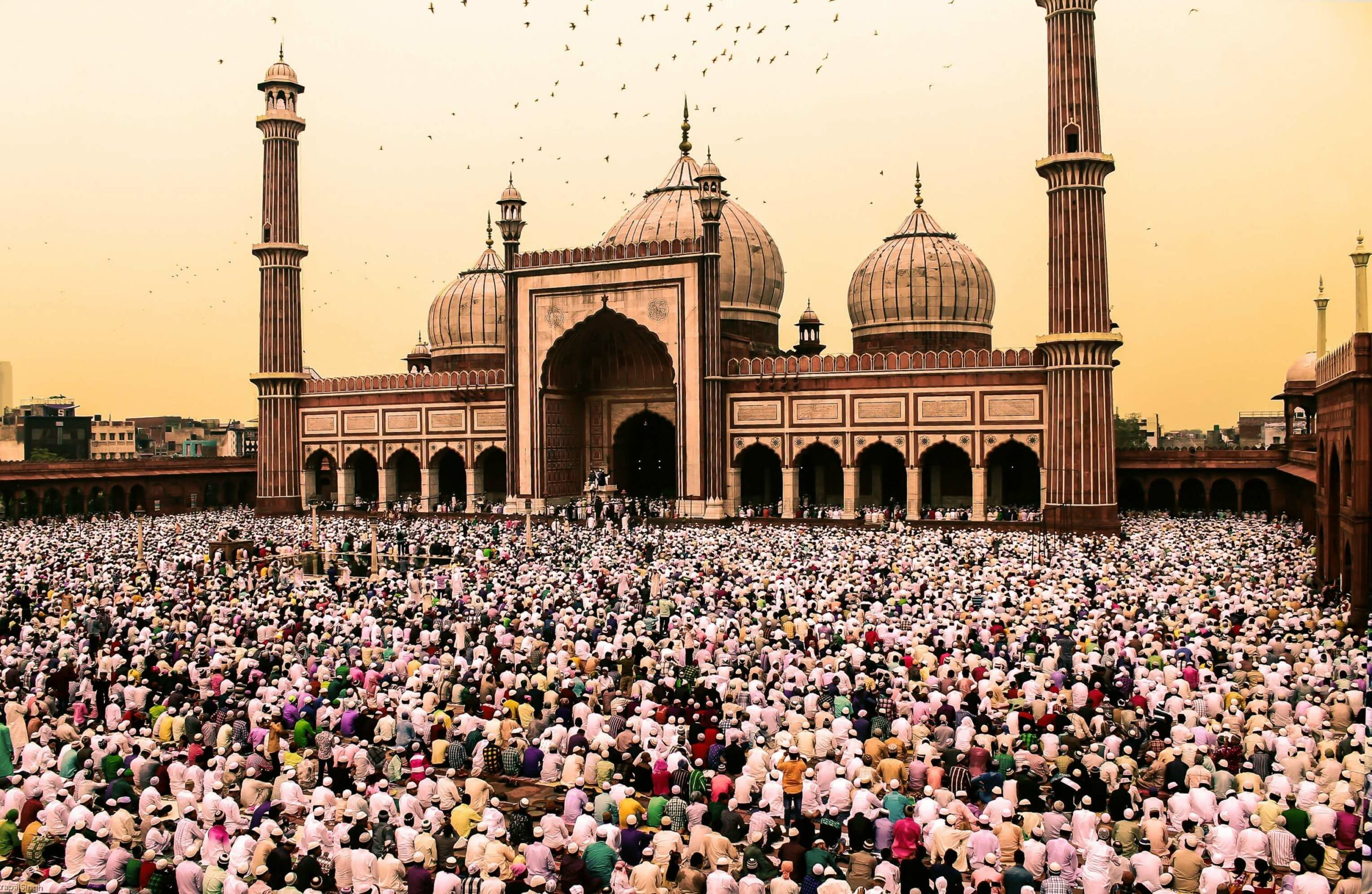
The day of Eid al-Adha begins with the Eid prayer, performed in congregation shortly after sunrise. It is one of the most attended prayers of the Islamic year, drawing together entire communities in mosques, open grounds, and public spaces across the world. The Prophet, peace be upon him, made attending the Eid prayer a communal obligation and encouraged even those who did not ordinarily attend the mosque, including women and children, to be present.
“He used to order the women, the virgins, and those who had their menses to come out for the Eid prayers, but he instructed those who had their menses to stay away from the prayer area.” (Sahih al-Bukhari)
The Eid prayer consists of two rakats with additional Takbeers, followed by the khutbah. The Prophet’s practice was to attend the Eid prayer before performing Qurbani, and this remains the established order for the day. After the prayer, the community disperses to perform their sacrifices, visit family, share food, and celebrate.
There are Sunnahs specific to Eid al-Adha that give the day its distinctive character. Unlike Eid al-Fitr, where the Sunnah is to eat before the prayer, on Eid al-Adha the Sunnah is to delay eating until after the Qurbani, so that the first food of the day comes from the sacrifice itself. The Takbeer should be recited from Fajr on the Day of Arafah through Asr on the 13th of Dhul Hijjah, announced aloud by men and said quietly by women: Allahu Akbar, Allahu Akbar, La ilaha illallah, Allahu Akbar, Allahu Akbar, wa lillahil hamd.
What Eid al-Adha Is Really Celebrating
Eid al-Adha is sometimes described primarily as a festival of meat or a day of feasting. That framing misses the point entirely. The celebration of Eid al-Adha is a celebration of what Ibrahim represented: the human being at their highest capacity for faith, obedience, and trust in Allah.
Ibrahim gave up his son. Most of us are being asked to give up a portion of our wealth. The gap between those two acts is enormous. Yet the principle connecting them is identical: the recognition that everything we have is a gift from Allah, and that our willingness to return it when asked is the measure of our faith.
This is why Allah describes the Eid prayer and the sacrifice as the two defining acts of pure worship in Surah Al-Kawthar.
“So pray to your Lord and sacrifice. Indeed, your enemy is the one cut off.” (Surah Al-Kawthar, 108:2)
Prayer directed entirely to Allah. Sacrifice performed entirely for Allah. No audience. No worldly return. This is the theological core of Eid al-Adha, and it is why the celebration that follows it carries a depth that ordinary festivities do not. You are not celebrating the completion of a religious checklist. You are celebrating having given something real for the sake of something eternal.
How to Celebrate with Full Intention
The Sunnah of Eid al-Adha is rich with specific practices that give the day its shape and meaning. Here is how to observe it fully.
- Recite Takbeer from Fajr on Arafah: The Takbeer begins on the morning of the 9th and continues through Asr on the 13th. Recite it aloud after every prayer and throughout the day.
- Attend the Eid prayer: The communal Eid prayer is one of the most significant gatherings of the Islamic year. Arrive early, dress well, and bring your family.
- Delay your first meal until after Qurbani: The Sunnah is to break your fast with meat from the sacrifice. This connects the celebration directly to the act of worship that gives it meaning.
- Perform or arrange Qurbani: If it is obligatory upon you, ensure it is performed on the 10th, 11th, or 12th of Dhul Hijjah. The 10th is preferred. Divide the meat between family, relatives, and the poor.
- Visit family and strengthen ties: Eid al-Adha is a day for community. Visit relatives, share food, and extend greetings. The Prophet encouraged the strengthening of family ties on the days of Eid.
- Give generously: Eid al-Adha is a day of generosity. Whether through Qurbani, additional charity, or simply sharing food with neighbours, giving is central to the spirit of the day.
A Celebration That Belongs to the Whole Ummah
One of the most powerful aspects of Eid al-Adha is its global simultaneity. On the same day, Muslims in Jakarta, Johannesburg, London, Cairo, Toronto, and Karachi are standing in the Eid prayer, performing Qurbani, and celebrating together. The Hajj pilgrims who spent the previous day at Arafah are completing their pilgrimage. The families who fasted the 9th are breaking their fast with the meat of their sacrifice. The poor in communities across the world are receiving Qurbani meat they could not otherwise afford.
This is the Ummah functioning as it was designed to: a community of believers distributed across the earth, unified by the same faith, the same calendar, and the same Lord. Eid al-Adha is not just a Muslim Christmas, as it is sometimes lazily described by those unfamiliar with it. It is a theological event rooted in the most foundational act of Islamic submission, celebrated by the most diverse single community of human beings on earth, on the same day, for the same reason.
“The day of Arafah, the day of sacrifice, and the days of Tashreeq are our Eid, the people of Islam. They are days of eating and drinking.” (Sunan al-Tirmidhi, graded Sahih)
Eid Mubarak: Celebrate What You Have Earned
Eid al-Adha is a celebration that is earned. It arrives after the best ten days of the year, after fasting the Day of Arafah, after the act of Qurbani, after the Eid prayer offered with the community, after the meat is shared with those who have nothing. By the time the day of celebration actually begins, the Muslim who has engaged with Dhul Hijjah fully has already given something real.
The joy of Eid al-Adha is the joy of Ibrahim after the trial: the relief, the gratitude, and the deep peace that comes from having been tested and having held firm. You are not required to have been tested at the level of Ibrahim. But you are invited, every year, to demonstrate a version of his willingness with what you have.
So celebrate fully. Wear your best. Pray with your community. Share your Qurbani meat. Call the relatives you have not spoken to. Feed the neighbours. And carry with you the awareness that what you are celebrating is not just a holiday. It is the proof, renewed every year, that this Ummah is still willing to give for the sake of Allah.
Eid Mubarak.