

The Ground Reality: Two Crises, One Ummah
Ramadan 2026 began this week with 1.9 billion Muslims observing the fast worldwide. For most, it arrived with the familiar rhythm of pre-dawn meals, long prayers, and the particular intimacy of breaking fast with loved ones. For two Muslim communities in particular, one in a coastal strip on the eastern Mediterranean, one in a vast country at the crossroads of sub-Saharan Africa and the Arab world, the month arrived inside a crisis so acute that the word ‘Ramadan’ itself carries a different moral gravity.
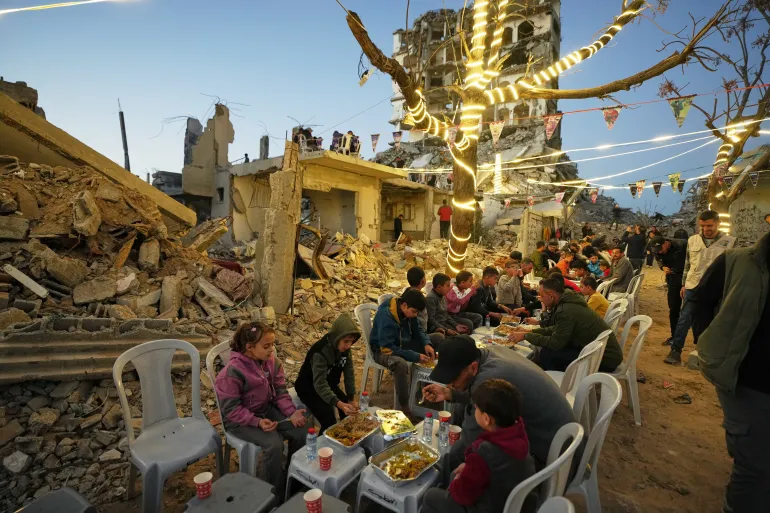
In Gaza, the ceasefire brokered in October 2025 has held barely. Israeli strikes killed at least two Palestinians in Jabalia and southern Gaza on the third day of Ramadan alone, bringing the total death toll since the ceasefire took effect to over 614. The overall death toll since October 2023 now exceeds 75,000, according to independent research published in The Lancet Global Health, 34.7% higher than official Palestinian Ministry of Health figures, which themselves stand at 72,063. More than 100 children have been killed since the ceasefire began, roughly one per day, according to UNICEF. For the families observing their third consecutive Ramadan under war, the season of collective worship has become inseparable from collective grief.
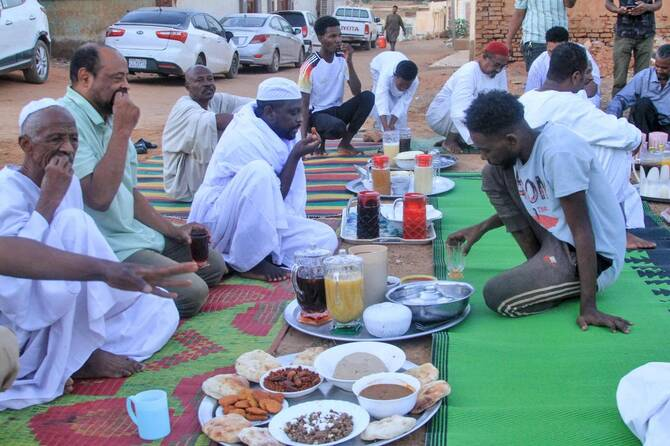
In Sudan, the scale of suffering has long since exceeded what most international media have been willing to hold in sustained attention. Three years of civil war between the Sudanese Armed Forces and the Rapid Support Forces have killed an estimated 150,000 people according to the IRC, displaced over 12 million internally, driven four million across international borders, and pushed 24.6 million, nearly half the population, into acute food insecurity. As Ramadan began, famine had been formally confirmed in Al Fasher and Kadugli. Over half of all children in Um Baru, a displacement camp in North Darfur, are suffering from acute malnutrition. For the Sudanese Muslim entering this Ramadan, the question of what to eat at Suhoor is not a matter of preference or habit. It is a negotiation for survival.
These two crises share a structural kinship that goes beyond the coincidence of the calendar. Both are sustained by the foreign policy calculations of states, some of them Muslim-majority, that have concluded their strategic interests outweigh the humanitarian cost of inaction. Both have produced conditions in which the most basic acts of Islamic observance, communal prayer, the breaking of the fast, and the gathering of family are either impossible, dangerous, or profoundly altered by violence and displacement. And both are unfolding, in different ways, largely outside the sustained moral attention of the global community.
The Islamic Intellectual Framework: When the Fast Meets the Fire
The Quran’s instruction for fasting is very clear: “O you who believe, fasting has been prescribed for you as it was prescribed for those before you, so that you may attain Taqwa” (Al-Baqarah, 2:183).
While Taqwa is often translated as piety, God-consciousness, or moral alertness, it isn’t just a passive feeling. Famous scholars like Ibn Qayyim and Ibn Kathir described it as a state of heightened awareness, the ability to clearly see the truth, feel when something is unfair, and act according to that realization. Ramadan serves as a yearly training ground to sharpen this exact skill.
The way the month is organized proves that its purpose is never just about the individual. From the shared pre-dawn Suhoor and the collective sunset Iftar to the nightly Taraweeh prayers that turn a mosque into a true community, every part of Ramadan connects us to others. Even the required charity, Zakat al-Fitr, is specifically designed to ensure no Muslim is without food for the celebration of Eid.
Every structural element of the month pushes us outward, moving from the individual toward the group. While the act of fasting is personal, the responsibility it creates is shared by everyone.
“Last Ramadan was famine and war at the same time. My little son used to pray for death because he craved food. Can you imagine? — Maisoon al-Barbarawi, Gaza, Al Jazeera, February 2026”
This is the religious framework we must use to understand the crises in Gaza and Sudan. In Islamic law, scholars like Imam al-Ghazali and Al-Shatibi defined the Maqasid al-Shariah, or the “Higher Objectives” of the faith. These are five basic rights that must be protected for every human being:
- Life (Hifz al-Nafs)
- Faith (Hifz al-Din)
- Intellect (Hifz al-Aql)
- Family/Lineage (Hifz al-Nasl)
- Property (Hifz al-Mal)
What we see in Gaza and Sudan isn’t just a distant political conflict. It is a direct attack on all five of these fundamental rights. It involves the killing of innocent people, the destruction of mosques, the starvation of children, the wiping out of entire family trees, and the destruction of the little wealth these communities had left.
Islamic tradition uses a term called Fard Kifayah. This refers to a duty that falls on the entire community. When a tragedy of this size happens, a Muslim cannot fulfil their duty simply by praying in private.
The responsibility is only fulfilled when the community as a whole takes action—not just by praying, but by documenting the truth, advocating for justice, providing financial support, and using every available means to apply pressure. A person who fasts while ignoring these realities has technically followed the rules. However, we must ask ourselves: if our hunger doesn’t move us to help those who are suffering, has that fast actually achieved Taqwa?
Gaza — The Third Ramadan in the Ruins
What the Ceasefire Has and Has Not Changed
The ceasefire that came into effect on October 10, 2025, ended the most intense phase of bombardment Gaza had endured since October 2023. It did not end the dying. Israeli airstrikes have continued since the ceasefire took effect, with 614 Palestinians killed in what should have been a period of protected recovery. On the third day of Ramadan 2026, strikes hit Jabalia in the north and the Qizan an-Najjar area in the south. For the residents of Gaza, the ceasefire has meant a reduction in the frequency of mass death, not its cessation.
The material conditions of daily life have improved in narrow, uneven ways. Gaza’s markets, devastated by two years of blockade, have seen some commercial activity return. Shelves that were empty now carry goods. But for the majority of Gaza’s 2.2 million residents, the overwhelming proportion of whom have been economically destroyed by the war, the presence of goods on shelves is academic. Employment has not returned. Infrastructure has not been rebuilt. The same families who relied on aid kitchens during the war continue to rely on them now.
“I have been without work for two and a half years. I cannot afford the current prices, even when goods are available. So we rely on charity kitchens. — Gaza resident, Middle East Eye, February 2026”
The Infrastructure of Loss
The scale of what was destroyed during the war cannot be understated as context for this Ramadan. The Gaza Ministry of Health has confirmed that Israel banned 37 international NGOs from operating in Gaza and the West Bank via a regulation announced on December 30, 2025, a move UN human rights experts described as part of ‘a systematic assault on humanitarian operations.’ Since October 2023, Israeli forces have killed over 500 humanitarian workers and at least 1,500 health workers, according to OHCHR. UNRWA, the largest provider of aid, healthcare, and essential services to Palestinians, has been effectively banned by Israeli law.
The destruction of religious infrastructure has been particularly acute. Mosques where generations gathered for Taraweeh, the nightly Ramadan prayers that are among the most spiritually dense collective experiences in Islamic life, have been bombed and reduced to rubble. Families who cannot reach their neighbourhoods because they lie inside Israeli-designated buffer zones observe Ramadan in tents and in the ruins of apartments, performing prayers in improvised spaces beside the remnants of a life they cannot yet return to. ‘The war has not stopped,’ one resident of Khan Younis told Al Jazeera. ‘I cannot even reach my home. I cannot see it because it lies in an area we are forbidden to enter.’
The Political Architecture
The conditions in Gaza are not solely the result of military necessity. They are the result of specific policy decisions taken by the Israeli government, a government under sustained pressure from its far-right coalition partners to resist any agreement that constrains military operations, settlement expansion, or Israeli control over Gaza’s future governance. Netanyahu’s office has stated that Hamas must disarm before reconstruction begins. Hamas has rejected this as a precondition. The result is a political deadlock in which the civilian population of Gaza, 56.2% of those killed being women, children, and the elderly, per The Lancet, bears the consequences of a negotiation that serves the interests of neither party to the conflict.
Trump’s Board of Peace summit in Washington, convened during the first days of Ramadan, produced pledges of $7 billion toward reconstruction from nine countries against an estimated $70 billion needed. The gap between what was pledged and what Gaza requires is not a rounding error. It is a political statement about how much Gaza’s recovery is valued by the states with the economic capacity to fund it.
Sudan — The Largest Crisis the World Is Barely Watching
One Thousand Days of War
In January 2026, Sudan passed 1,000 days of civil conflict between the Sudanese Armed Forces and the Rapid Support Forces. The UN Under-Secretary-General for Political Affairs, Rosemary DiCarlo, described it to the Security Council as 1,000 days of staggering violence and unimaginable suffering and 1,000 days of total impunity for perpetrators of a long list of atrocities and war crimes. The numbers that accompany that description are, by any measure, among the most severe of any conflict active on earth today.
The IRC estimates the death toll at over 150,000, though Operation Broken Silence, which tracks the conflict closely, notes this figure may be a severe undercount given the near-total collapse of data infrastructure across conflict zones. More than 12 million people have been internally displaced. Thirty million, two-thirds of the population, are in need of humanitarian assistance. Sudan now accounts for approximately 10% of global humanitarian needs. The IRC has described it as the largest humanitarian crisis ever recorded.
Famine as a Weapon and a Consequence
The UN Fact-Finding Mission on Sudan formally concluded that the RSF used starvation as a method of warfare a war crime under international humanitarian law. The mechanism is documented in granular detail: deliberate blockades of aid convoys, systematic looting of food supplies, destruction of agricultural infrastructure, and the targeting of markets and granaries in civilian areas. In West Kordofan, the SAF bombed a mosque on June 21, killing 41 people. In Zamzam, RSF attacks killed between 300 and 1,500 the majority women and children. In Omdurman, a market shelling left 54 dead and over 100 injured.
The famine that resulted is now confirmed in multiple locations. IPC data released in February 2026 confirmed that in Um Baru, over half of all children under five are suffering acute malnutrition exceeding the threshold at which famine is formally declared. In Kernoi, the figure is 34%. In Kadugli, famine conditions confirmed since September 2025 may be ‘temporary’ in the wake of the SAF breaking the RSF siege, but FEWS NET has warned that siege-like conditions may be re-established between February and May. The relief, where it exists, is fragile and contingent on the continued willingness of both parties not to re-impose it.
“There are families forced to eat tree leaves and grass to survive. Five children from one family died from poisoning after eating grass. — Aid worker in Dilling, PBS NewsHour, February 2026”
The Geopolitical Architecture of Indifference
Sudan’s civil war is not a conflict without external authors. The UAE has provided documented material support, weapons, mercenaries, and resources to the RSF, a fact confirmed by multiple investigations and acknowledged implicitly by the scale of RSF military capacity relative to its nominal status as a paramilitary group. Egypt has backed the SAF. Russia, through Wagner Group-aligned networks, has maintained a presence in the conflict. The United States, whose USAID funding closures have directly contributed to the shutdown of over 60% of Sudan’s emergency food kitchens, has simultaneously attempted to position itself as a mediator.
The UK Foreign Secretary, following a visit to the Sudan-Chad border in February 2026, told the UN Security Council that up to 7 million people now face famine equivalent to the entire population of London. She warned that RSF advances on El Obeid risk turning it into another El Fasher, where satellite imagery confirmed mass killings following the RSF takeover in October 2025. The UN’s own human rights chief described the atrocities in El Fasher as carrying ‘hallmarks of genocide’ against the Zaghawa and Fur communities. The Security Council has met, deliberated, and issued statements. The killing has continued.
Sudan is a Muslim-majority country. The RSF’s ideological framework draws on an Arab supremacist ideology that targets non-Arab African Muslim communities, the same communities that bore the brunt of the Janjaweed violence in Darfur in the early 2000s. The perpetrators are, in significant part, the same networks. The ethnic and religious dimensions of the targeting are documented and undisputed. What has changed since Darfur is not the nature of the atrocity. It is the degree to which the international community, including Muslim-majority states with the diplomatic and economic leverage to act, has elected to treat it as a manageable externality rather than an emergency demanding an immediate response.
The Collective Good: The Obligation This Ramadan Places on the Ummah
Ramadan is, among other things, a rehearsal for the collective conscience. The fast makes the body remember what hunger is. The nightly prayer makes the community remember that it is not a collection of individuals, but a body with shared obligations. The Zakat al-Fitr makes explicit what the fast implies: that the end of this month must find no one without food. These are not pious aspirations. They are structural requirements of the observance itself.
The situations in Gaza and Sudan sit in direct tension with every one of those requirements. In Gaza, a Muslim-majority population is entering its third Ramadan under conditions of war, displacement, and deliberately engineered food insecurity sustained in part by the diplomatic and military support of states that consider themselves allies of the rule-based international order. In Sudan, a Muslim-majority population is dying at a rate and scale that has been formally characterised as genocidal by the UN’s own investigators, sustained in part by the weapons and political cover of Muslim-majority states whose governments have calculated that the strategic cost of intervention exceeds the humanitarian cost of inaction.
The Muslim who fasts in safety this Ramadan in London, Dubai, Karachi, Jakarta, or Toronto shares the Niyyah, the obligation, and the Quranic verse with the Palestinian who breaks fast on charity kitchen food cooled over a wood fire, and the Sudanese mother whose children are eating leaves. The spiritual weight of that connection is not symbolic. It is the substance of what the Ummah means. And the fard kifayah that flows from it is not discharged by awareness. It is discharged by action.
For Muslim media, that action is rigorous, sourced, unflinching, and trusted by its audience to tell the truth about what is happening to Muslim communities in the world. For Muslim civil society, it is advocacy sustained, organised, and directed at the specific decision-makers whose choices are sustaining these crises. For Muslim governments, it is diplomatic and economic pressure applied with the seriousness that the scale of these situations warrants, and not calibrated primarily by strategic self-interest. For individual Muslims, it is Zakat and Sadaqah directed with intention toward the organisations that still have access and the political voice to demand that access be maintained and expanded.
Taqwa, in the end, is not a feeling. It is a posture toward the world, one that sees clearly, refuses comfort in the face of injustice, and acts with the knowledge that what we do and fail to do in this world is accounted for. This Ramadan, the accounting is unusually clear.
Key Takeaways
- Gaza enters Ramadan 2026 under a fragile ceasefire with Israeli strikes continuing, 614 killed since October 2025. The Lancet independently verified over 75,000 violent deaths since October 2023, 34.7% higher than official figures. UNICEF reports one child killed per day since the ceasefire.
- Sudan is the world’s largest humanitarian crisis by multiple measures: 150,000+ dead, 12 million internally displaced, 30 million in need of aid, and famine confirmed in multiple locations. Over half of the children in Um Baru suffer acute malnutrition.
- Both crises are sustained by the foreign policy calculations of external actors, including Muslim-majority states, whose strategic interests have been prioritised over humanitarian obligations. The UAE’s documented support for the RSF and diplomatic paralysis around Gaza represent collective failures of Muslim political leadership.
- The Maqasid al-Shariah framework identifies what is happening in both theatres as simultaneous assaults on Hifz al-Nafs, Hifz al-Din, and Hifz al-Nasl, triggering not just individual sympathy but collective fard kifayah.
- Taqwa, the central objective of Ramadan, demands not just awareness of these realities but an active response: financial, political, journalistic, and diplomatic. Ramadan’s spiritual architecture was never designed to coexist with indifference to injustice at this scale.